Excretory System: Organs, Functions, and How the Body Removes Waste
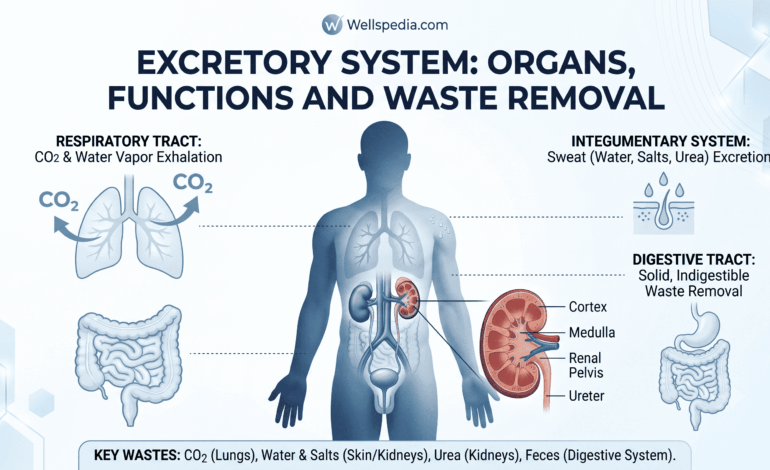
Every day, the human body produces waste as cells use nutrients and carry out normal metabolic activities. The excretory system helps remove these unwanted substances while keeping water, minerals, electrolytes, and acid levels within a healthy range.
The urinary system plays the central role in this process. The kidneys filter the blood and produce urine, while the ureters, bladder, and urethra transport, store, and eliminate urine. However, waste removal does not depend on the urinary system alone. The lungs, digestive tract, and skin also contribute to excretion.
Understanding how these organs work together can make it easier to understand kidney health, urinary function, hydration, and other aspects of the body’s internal balance.
What Is the Excretory System?
The excretory system is the group of organs and processes that help the body remove metabolic waste.
Cells continuously perform chemical reactions to produce energy and maintain normal body functions. These reactions also create substances that the body no longer needs. If these wastes remain in the body, they can interfere with normal cellular and organ function.
The excretory system helps remove these substances while also supporting homeostasis, which means keeping the body’s internal environment stable.
The kidneys are especially important because they filter the blood and regulate several substances at the same time.
Excretion vs. Elimination: What Is the Difference?
The terms excretion and elimination are closely related, but they describe different parts of waste removal.
What Is Excretion?
Excretion refers to the removal of waste products created through normal metabolic processes.
For example, the kidneys excrete certain waste substances through urine, while the lungs remove carbon dioxide when we breathe out.
What Is Elimination?
Elimination describes the broader movement of unwanted substances out of cells and, ultimately, out of the body.
Because cells throughout the body produce waste, several organs and organ systems participate in this overall process.
Main Organs of the Excretory System
Several organs contribute to waste removal. The major ones include:
- Kidneys
- Ureters
- Bladder
- Urethra
- Lungs
- Digestive tract
- Skin
Among these organs, the kidneys have a particularly important role because they filter blood, remove waste, and regulate fluid and electrolyte levels.
The kidneys, ureters, bladder, and urethra together form the urinary system.
The Urinary System
The urinary system is also called the renal system. Its primary job is to process waste from the blood and remove it from the body as urine.
The main parts are:
Kidneys
The kidneys filter the blood and produce urine.
Ureters
The ureters are narrow tubes that carry urine from each kidney to the bladder.
Bladder
The bladder temporarily stores urine until a person is ready to urinate.
Urethra
The urethra carries urine from the bladder out of the body.
Besides waste removal, the urinary system contributes to the regulation of:
- Blood pressure
- Blood pH
- Fluid levels
- Electrolytes
- Water balance
Kidneys: The Body’s Main Filtration Organs
Most people have two kidneys. These bean-shaped organs receive a large supply of blood through the renal arteries.
The kidneys remove unwanted substances from the bloodstream and use the filtered fluid to form urine. The urine then travels through the ureters and reaches the bladder for storage.
However, kidney function involves much more than simply producing urine. The kidneys constantly adjust the amount of water, minerals, and other substances that remain in the bloodstream.
How Do the Kidneys Control Their Function?
Kidney activity responds to signals from hormones, nerves, blood pressure, and the kidneys’ own internal control mechanisms.
Hormonal and Nervous Regulation
The brain and nervous system can influence kidney activity.
For example, changes in blood composition and nerve signals can affect hormone release. These hormones then influence how the kidneys handle water, sodium, blood flow, and other substances.
The sympathetic nervous system can also affect blood vessels within the kidneys and therefore influence blood flow and filtration.
Kidney Autoregulation
The kidneys also have built-in mechanisms that help them maintain relatively stable blood flow and filtration despite changes in blood pressure.
This process is called renal autoregulation.
In simple terms, the kidneys can adjust the behavior of their small blood vessels so filtration remains appropriately controlled.
Major Functions of the Kidneys
The kidneys perform several important functions. Two major roles involve waste removal and fluid regulation.
1. Waste Removal
The kidneys filter blood and remove substances that the body needs to eliminate.
The source describes the kidneys as filtering a very large volume of fluid each day, with much of that filtered fluid later being reabsorbed. This process allows the kidneys to remove waste while conserving substances the body still needs.
Waste substances found in urine can include:
- Urea
- Creatinine
- Uric acid
- Ammonia
- Excess electrolytes
- Excess water
- Other metabolic waste products
The liver also contributes to waste processing. For example, it produces urea from nitrogen-containing waste, after which the bloodstream carries urea to the kidneys for removal.
The Nephron: The Kidney’s Functional Unit
A nephron is the microscopic functional unit of the kidney.
Each kidney contains a very large number of nephrons. These tiny structures filter blood, recover useful substances, and help form urine.
The nephron includes several specialized regions.
Glomerulus
The glomerulus is a network of tiny blood vessels located inside the renal corpuscle.
It filters blood plasma and allows water and small molecules to enter the nephron while normally retaining blood cells and larger proteins within the bloodstream.
Renal Corpuscle
The renal corpuscle contains the glomerulus and the surrounding Bowman’s capsule.
This structure receives the initial filtrate produced during blood filtration.
Renal Tubules
After filtration, the fluid enters the renal tubules.
These tubules gradually modify the filtrate by returning useful substances to the blood and leaving unwanted substances in the fluid that eventually becomes urine.
The major tubular sections include:
- Proximal convoluted tubule
- Loop of Henle
- Distal convoluted tubule
- Collecting duct
Proximal Convoluted Tubule
The proximal convoluted tubule recovers many substances that the body still needs.
These include:
- Water
- Glucose
- Amino acids
- Electrolytes
- Other useful molecules
It also helps remove certain substances from the blood and contributes to acid-base regulation.
Loop of Henle
The loop of Henle helps the kidneys control water and electrolyte balance.
Its descending portion allows water to move out of the tubular fluid, while the ascending portion actively transports certain electrolytes and has limited water permeability.
This arrangement helps the kidney concentrate urine when necessary.
Distal Convoluted Tubule
The distal convoluted tubule performs additional adjustments to the filtered fluid.
It helps regulate sodium and other electrolytes and contributes to acid-base balance.
Hormones can influence water handling in the later parts of the nephron and collecting duct.
Collecting Ducts
Collecting ducts receive fluid from the nephrons and help determine the final concentration of urine.
They also contribute to the body’s regulation of water and electrolytes before urine moves toward the ureters.
Types of Nephrons
The kidneys contain two major types of nephrons:
Cortical Nephrons
Most nephrons belong to this group and are located mainly in the outer region of the kidney.
Juxtamedullary Nephrons
These nephrons lie closer to the inner region of the kidney and have longer loops of Henle.
Their structure supports the kidney’s ability to concentrate urine and conserve water.
The supplied source describes cortical nephrons as making up approximately 85% of nephrons and juxtamedullary nephrons as approximately 15%.
The Kidneys Also Produce Important Hormones
The kidneys do more than filter blood. They also have important endocrine functions, meaning they produce or activate substances that influence other parts of the body.
Important kidney-related hormones and hormone pathways include:
Renin
Renin participates in the renin-angiotensin system, which helps regulate blood pressure, blood volume, and sodium balance.
Erythropoietin
The kidneys produce erythropoietin, a hormone that stimulates the bone marrow to produce red blood cells.
Therefore, impaired kidney function can affect red blood cell production.
Vitamin D Activation
The kidneys help convert vitamin D into its active form, calcitriol.
Active vitamin D contributes to calcium regulation and several other body processes.
How the Kidneys Maintain Water and Electrolyte Balance
The body needs the right amount of water and minerals to function properly.
The kidneys constantly adjust the amount of water and electrolytes that they return to the bloodstream or remove through urine.
Important electrolytes include:
- Sodium
- Potassium
- Calcium
- Magnesium
- Chloride
Sodium plays a major role in extracellular fluid balance, while potassium is particularly important for cellular function.
Hormones such as renin, angiotensin II, aldosterone, and antidiuretic hormone (ADH) help coordinate these processes.
Antidiuretic Hormone and Water Conservation
ADH helps the kidneys conserve water.
When the body needs to retain more water, ADH increases the permeability of parts of the kidney’s collecting system. More water can then return to the bloodstream, resulting in more concentrated urine.
This mechanism helps protect the body’s fluid balance.
The Bladder: Where Urine Is Stored
The bladder is a muscular organ located in the lower part of the urinary system.
Its main job is to store urine until urination becomes appropriate.
Urine enters the bladder through the ureters and remains there until it passes through the urethra.
The bladder wall contains a powerful muscle called the detrusor muscle. Sphincter muscles around the bladder outlet help control when urine leaves the bladder.
What Are the Main Functions of the Bladder?
The bladder has two clearly established major functions: storage and urine release.
1. Urine Storage
As the bladder fills, the detrusor muscle generally remains relaxed while the sphincters help keep urine inside.
As pressure increases, nerves in the bladder send signals to the brain. These signals create the sensation that a person needs to urinate.
2. Urine Excretion
During urination, the bladder muscle contracts and the urinary sphincters relax.
This coordinated action allows urine to move through the urethra and leave the body.
The nervous system plays an important role in coordinating this process.
Does the Bladder Reabsorb Water?
The bladder has traditionally been viewed mainly as a storage and excretion organ.
Research has explored whether bladder tissue can absorb small amounts of water or certain substances from stored urine. Evidence described in the supplied source includes observations from animal studies involving small amounts of nitrogen-containing substances.
However, significant reabsorption of these substances has not been demonstrated in humans.
Other Organs Involved in Excretion
The urinary system handles a major portion of metabolic waste, but other organs also contribute.
These include the:
- Digestive system
- Respiratory system
- Skin
Each system removes different types of waste.
Digestive System and Waste Removal
The digestive system eliminates solid waste through bowel movements.
Feces can contain:
- Water
- Undigested food components
- Fiber
- Intestinal bacteria
- Shed intestinal cells
- Unabsorbed substances
- Microbial products
The digestive tract moves food and waste through coordinated muscular contractions called peristalsis.
When stool reaches the rectum, stretching of the rectal wall sends signals to the nervous system. This produces the urge to have a bowel movement.
Lungs and Excretion
The lungs remove gaseous metabolic waste during breathing.
The most important waste product is carbon dioxide, which the body produces during cellular energy metabolism.
The lungs also release some water vapor when we breathe out.
Therefore, every breath helps remove carbon dioxide from the bloodstream and replace it with oxygen from the surrounding air.
Skin and Sweat
The skin primarily protects the body from the external environment and helps control body temperature.
Sweating also contributes to waste removal, although this role is much smaller than the kidneys’ role.
Sweat mainly contains:
- Water
- Sodium and other mineral salts
- Small amounts of other substances
The major purpose of sweating is cooling the body, rather than removing large amounts of metabolic waste.
Why Is the Excretory System Important?
The excretory system is essential because the body cannot function normally when metabolic waste, excess water, or electrolytes accumulate.
The kidneys are especially important because they simultaneously:
- Filter the blood
- Remove metabolic waste
- Produce urine
- Control water balance
- Regulate electrolytes
- Support acid-base balance
- Participate in blood pressure regulation
- Produce or activate important hormones
The lungs, digestive tract, and skin support this process by removing other forms of waste.
Final Takeaway
The excretory system is a coordinated network that keeps the body’s internal environment stable.
The kidneys act as the main filtration organs, while the ureters transport urine, the bladder stores it, and the urethra carries it out of the body. At the same time, the lungs remove carbon dioxide, the digestive system eliminates solid waste, and the skin contributes to waste removal through sweating.
Together, these organs help maintain fluid balance, electrolyte levels, blood chemistry, and overall homeostasis.
Understanding how the excretory system works can also help people recognize why kidney, urinary, respiratory, digestive, and hydration health are closely connected.
Medical Disclaimer: This article is intended for general educational purposes and does not replace professional medical advice, diagnosis, or treatment. If you have concerns about kidney function, urination, fluid balance, or other symptoms, consult a qualified healthcare professional.