Minoxidil for Hair Loss: How It Works, Side Effects, Results and Safety
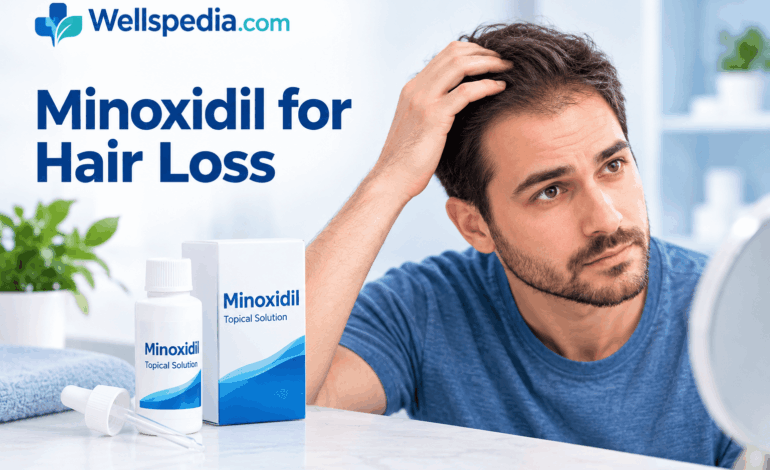
Hair thinning and baldness can affect confidence at almost any age. When people notice a widening part, a receding hairline, or increased shedding, minoxidil for hair loss is often one of the first treatments they consider.
Minoxidil is an established treatment for certain types of hair loss, particularly androgenetic alopecia, also called male pattern hair loss or female pattern hair loss. It is available in topical formulations such as solutions and foams, and some formulations can be purchased without a prescription.
However, minoxidil does not work for every type of hair loss. Understanding how minoxidil works, its possible side effects, how long it takes to show results, and when a doctor should evaluate hair loss can help you make a safer decision.
What Is Minoxidil?
Minoxidil is a medication used topically on the scalp to encourage hair growth in certain forms of hair loss.
It is also widely recognized by the brand name Rogaine, although many generic minoxidil products are available.
Research supports topical minoxidil as an effective treatment for androgenetic alopecia. Clinical evidence shows that it can increase hair growth compared with placebo, although the amount of regrowth varies from person to person.
Minoxidil is not a permanent cure for hereditary hair loss. If it works, continued use is generally necessary to maintain the benefit. Stopping treatment can lead to the gradual loss of the hair that was maintained or regrown during treatment.
Why Was Minoxidil Originally Developed?
Minoxidil was not originally created as a hair-loss medication.
It was developed as a medication that affects blood vessels and was later used to treat severe high blood pressure. Increased hair growth was observed as an unexpected effect, which eventually led researchers to investigate minoxidil as a treatment for baldness.
This discovery helped establish topical minoxidil as one of the best-known medical treatments for pattern hair loss.
Today, topical minoxidil is commonly used for androgenetic alopecia, while oral minoxidil is a different formulation that requires medical supervision because it can have cardiovascular effects.
How Does Minoxidil Work for Hair Loss?
The exact biological mechanism by which topical minoxidil promotes hair growth is not completely understood.
Hair follicles naturally move through a growth cycle:
- Anagen – growth phase: The follicle actively produces a hair shaft.
- Catagen – transition phase: Active growth slows and the follicle changes.
- Telogen – resting phase: The follicle temporarily rests.
- Exogen – shedding phase: The old hair is released.
Minoxidil appears to influence the hair-growth cycle and can help some follicles remain in or return to an active growth phase. It may also increase the size of miniaturized follicles and improve the thickness of individual hairs.
The result is that some people experience less visible thinning and increased hair density after consistent treatment.
The exact mechanism is still being studied, so it is more accurate to say that minoxidil supports hair growth rather than claiming that it simply “increases blood flow to the scalp.”
Does Minoxidil Actually Work?
Yes, topical minoxidil can work for some people with pattern hair loss.
A systematic review and meta-analysis found topical minoxidil to be more effective than placebo for increasing hair growth in androgenetic alopecia. However, the response is not identical for everyone, and cosmetically noticeable regrowth occurs only in a portion of users.
The American Academy of Dermatology also notes that minoxidil can stimulate hair growth and reduce further hair loss, but it cannot restore an entire head of hair.
What affects the results?
Your response can depend on:
- The underlying cause of hair loss
- How advanced the hair loss is
- How consistently treatment is used
- The formulation and concentration
- Individual response to the medication
- How long treatment is continued
Earlier treatment of pattern hair loss may provide a better opportunity to preserve existing follicles.
How Long Does Minoxidil Take to Work?
One of the most common questions is: “How long does minoxidil take to work?”
The answer varies.
Some product labels indicate that early changes may appear after about two months, while some people need at least four months before noticeable results become apparent. Dermatology guidance commonly advises giving treatment around 6 to 12 months to properly judge the response.
Hair grows slowly, so expecting dramatic changes within a few weeks can lead to unnecessary disappointment.
Taking photographs under similar lighting every few months can be more useful than checking your hair in the mirror every day.
Is Increased Hair Shedding Normal After Starting Minoxidil?
Some people notice more hair shedding after starting minoxidil.
This can be alarming, but temporary increased shedding can occur during the early treatment period as hair follicles shift through their growth cycle. The American Academy of Dermatology reports that some women may experience increased shedding during the first two to eight weeks.
However, not every episode of hair loss after starting minoxidil should automatically be considered normal.
If shedding is severe, persistent, patchy, or accompanied by scalp inflammation or other symptoms, speak with a dermatologist.
Common Minoxidil Side Effects
Topical minoxidil is generally tolerated by many users, but side effects can occur.
The most commonly reported problems involve the scalp and may include:
- Itching
- Dryness
- Redness
- Scaling or flaking
- Scalp irritation
- Burning or stinging
- Contact dermatitis
Some people can also develop unwanted hair growth outside the scalp, particularly if the medication spreads to the face or other areas.
A foam formulation may be easier for some people to tolerate than a solution, particularly when scalp irritation is related to ingredients in the formulation.
Serious Minoxidil Side Effects: When Should You Stop?
Although serious reactions are uncommon with properly used topical minoxidil, certain symptoms should not be ignored.
Stop using the product and seek medical advice if you develop symptoms such as:
- Chest pain
- Rapid or unusual heartbeat
- Dizziness or fainting
- Sudden unexplained weight gain
- Swelling of the hands or feet
- Significant scalp irritation or redness
- Unwanted facial hair growth
These warnings are included in current topical minoxidil product labeling.
If someone accidentally swallows minoxidil, medical help should be obtained promptly because the medication is intended for external use.
Minoxidil for Men
Topical minoxidil is commonly used for male pattern hair loss, particularly gradual thinning on the crown or top of the scalp.
Current U.S. product labeling for certain 5% minoxidil solutions is specifically intended for adult men with gradual thinning on the top of the scalp and states that the product is not intended for a receding frontal hairline.
This does not mean that every man with hair loss should automatically start minoxidil.
Sudden, patchy, unexplained, or inflammatory hair loss should first be evaluated because it can have causes that require different treatment.
Minoxidil for Women
Minoxidil is also used to treat female pattern hair loss.
The American Academy of Dermatology identifies minoxidil as a commonly recommended treatment for female pattern hair loss. Depending on the product and circumstances, 2% and 5% formulations may be used.
Women should pay particular attention to product labeling because formulations can have different instructions and approvals.
Unwanted facial hair is a possible adverse effect, particularly if the medication comes into contact with areas outside the scalp.
Can You Use Minoxidil During Pregnancy or Breastfeeding?
Minoxidil should not be used during pregnancy or breastfeeding without medical advice.
Current product labeling warns that topical minoxidil may be harmful during pregnancy or breastfeeding. The American Academy of Dermatology similarly advises women who are pregnant, planning pregnancy, or breastfeeding to avoid minoxidil for female pattern hair loss.
If you are pregnant, trying to conceive, or breastfeeding and experiencing hair loss, discuss safer options with your healthcare professional.
Who Should Not Start Minoxidil Without Medical Advice?
Minoxidil is not appropriate for every person experiencing hair loss.
You should seek medical evaluation rather than simply starting an over-the-counter product if your hair loss is:
- Sudden
- Patchy
- Unexplained
- Associated with scalp redness, pain, or inflammation
- Associated with scarring
- Appearing without a typical family pattern
- Beginning after a significant illness or nutritional problem
Current product labeling also advises against use in children and warns against applying certain products to an irritated or infected scalp. People with heart disease should consult a doctor before using topical minoxidil.
What Happens If You Stop Minoxidil?
Minoxidil is generally a maintenance treatment, not a permanent cure.
If it successfully maintains or regrows hair, stopping treatment can cause the benefits to disappear over time. The hair supported by treatment may gradually become thinner and shedding can increase again.
For this reason, it is important to understand the long-term commitment before starting treatment.
Minoxidil vs. Other Hair-Loss Treatments
Minoxidil is only one option for treating hair loss.
Depending on the diagnosis, a dermatologist may consider:
- Finasteride
- Other prescription medications
- Low-level laser therapy
- Hair transplantation
- Treatment of an underlying medical or nutritional condition
- Combination treatment
The appropriate option depends on the type and cause of hair loss.
For example, minoxidil alone is not an appropriate treatment for every type of alopecia. Some inflammatory or scarring forms of hair loss require treatment aimed at controlling inflammation or preventing permanent follicle damage.
Minoxidil and Finasteride: Are They the Same?
No.
Both medications are used in the management of certain forms of pattern hair loss, but they work differently.
Minoxidil is primarily used to stimulate and maintain hair growth.
Finasteride affects the hormonal pathway involved in androgenetic hair loss and is a prescription medication for appropriate patients.
A dermatologist can determine whether either medication, or a combination, is appropriate based on the person’s diagnosis, age, sex, medical history, and treatment goals.
Topical Minoxidil vs. Oral Minoxidil
These should not be treated as interchangeable products.
Topical minoxidil is applied directly to the scalp and is widely used for pattern hair loss.
Oral minoxidil is a systemic medication. Because it can affect blood pressure, heart rate, and fluid balance, it requires medical supervision when prescribed for hair loss.
A 2025 systematic review found that oral minoxidil may have comparable hair-density outcomes to topical minoxidil in some studies, but this does not mean oral minoxidil is automatically safer or better for everyone.
Do not take oral minoxidil for hair loss unless it has been prescribed or recommended by a qualified healthcare professional.
How to Use Minoxidil More Safely
If a healthcare professional or the product label recommends topical minoxidil for you:
- Apply it only as directed.
- Use it on the scalp rather than other parts of the body.
- Avoid contact with the eyes.
- Wash your hands after application.
- Allow the product to dry properly.
- Do not use more than recommended in an attempt to accelerate results.
- Keep the product away from children and pets.
- Follow the specific instructions supplied with your formulation.
Using a larger amount does not necessarily produce faster hair growth and can increase the risk of unwanted effects. Current product labeling specifically advises against using more or applying it more frequently than directed.
When Should You See a Dermatologist for Hair Loss?
Consider seeing a dermatologist if:
- Hair loss develops suddenly
- You notice bald patches
- Your scalp becomes painful, red, or inflamed
- You have significant itching or scaling
- Eyebrow or eyelash hair is also falling out
- Hair loss continues despite treatment
- You are unsure why your hair is thinning
- You are pregnant or breastfeeding
- You have another medical condition or take medications that may contribute to hair loss
Finding the cause is important because treatments differ depending on the diagnosis.
Frequently Asked Questions About Minoxidil
Does minoxidil really work for hair loss?
Yes. Clinical evidence shows that topical minoxidil can improve hair growth in androgenetic alopecia, although the response varies and complete restoration of lost hair should not be expected.
How long does minoxidil take to show results?
Some users may notice early changes within a few months, but dermatology guidance commonly recommends allowing around six to 12 months to properly assess the response.
Is minoxidil shedding normal?
Temporary increased shedding can occur during the early treatment period. However, severe, prolonged, patchy, or unexplained hair loss should be evaluated by a healthcare professional.
What are the most common minoxidil side effects?
Scalp irritation, dryness, itching, redness, and scaling are among the commonly reported topical effects. Unwanted hair growth outside the scalp can also occur.
Can women use minoxidil?
Minoxidil is used for female pattern hair loss, but women should follow the instructions for the specific formulation and discuss treatment with a healthcare professional when appropriate. It should be avoided during pregnancy and breastfeeding.
What happens when you stop minoxidil?
The benefits are not usually permanent. If minoxidil has been maintaining or regrowing hair, stopping treatment can cause those benefits to gradually disappear.
Can minoxidil regrow a receding hairline?
Results depend on the type and location of hair loss. Some current 5% topical product labels specifically indicate use for thinning on the top/vertex of the scalp and not for frontal baldness or a receding hairline.
Is Rogaine the same as minoxidil?
Rogaine is a brand associated with minoxidil products. Minoxidil is the active medication, and other brands and generic products are also available.
Final Takeaway
Minoxidil can be an effective treatment for certain types of hair loss, especially androgenetic alopecia, but it is not suitable for every cause of thinning or baldness.
The most important points are to identify the cause of hair loss, use the appropriate formulation as directed, understand that results take time, and recognize possible side effects.
Temporary shedding can occur early in treatment, while scalp irritation and unwanted hair growth are among the more commonly recognized adverse effects. More concerning symptoms such as chest pain, rapid heartbeat, fainting, swelling, or sudden unexplained weight gain require medical attention.
If your hair loss is sudden, patchy, painful, inflamed, or unexplained, speak with a dermatologist before beginning self-treatment.
Medical disclaimer: This article is for educational purposes and does not replace diagnosis or individualized medical advice. Always read the product label and consult a qualified healthcare professional before starting or changing treatment.
Sources and Medical References
- American Academy of Dermatology — Hair loss diagnosis and treatment.
- American Academy of Dermatology — Male pattern hair loss treatment.
- American Academy of Dermatology — Female pattern hair loss.
- PubMed — Systematic review and meta-analysis of topical minoxidil.
- DailyMed — Current topical minoxidil drug labeling.