Serious Games in Healthcare: Latest Gamification Developments, Benefits, and Applications
Introduction
Technology is changing the way healthcare is delivered, and one of the emerging approaches is the use of serious games in healthcare. Unlike conventional video games that are primarily designed for entertainment, serious games are developed with a specific purpose, such as rehabilitation, medical education, cognitive training, behavioral support, or patient engagement.
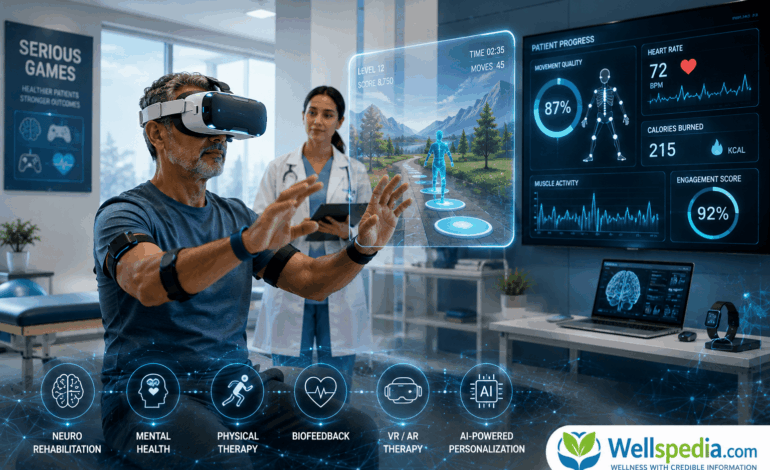
These games can turn repetitive healthcare activities into interactive experiences. When combined with technologies such as artificial intelligence (AI), virtual reality (VR), augmented reality (AR), wearable sensors, and biofeedback, they may provide patients and healthcare professionals with new ways to support treatment and monitor progress.
However, serious games are not a replacement for doctors, therapists, medication, or conventional treatment. Their value depends on the specific application and the quality of clinical evidence supporting it.
What Are Serious Games in Healthcare?
Serious games are interactive digital applications created for a purpose beyond entertainment. In healthcare, their objectives may include improving physical movement, supporting psychological interventions, teaching health information, encouraging exercise, or helping patients follow treatment plans.
Examples include:
- Rehabilitation games for stroke recovery
- Motor-training games for neurological conditions
- Cognitive training applications
- Mental health and CBT-based games
- Virtual reality therapy
- Exercise and physical therapy games
- Patient education games
- Medication reminder applications
- Medical training simulations
Serious Games vs. Gamification
Although these terms are often used together, they are slightly different.
Gamification involves adding game-like features—such as points, badges, rewards, challenges, or progress levels—to an existing healthcare activity.
Serious games are complete game-based experiences designed around a specific educational, therapeutic, or healthcare objective.
Both approaches aim to increase motivation and engagement.
Major Applications of Serious Games in Healthcare
1. Neurological Rehabilitation
Neurological rehabilitation often requires patients to perform the same movements repeatedly. This can become tiring or boring, potentially affecting motivation.
Serious games can make these exercises more interactive. Motion sensors, cameras, controllers, or wearable devices can track movements and allow patients to control objects or characters within a digital environment.
Potential applications include rehabilitation for:
- Stroke
- Parkinson’s disease
- Traumatic brain injury
- Multiple sclerosis
- Other neurological movement disorders
For example, a rehabilitation game may ask a patient recovering from stroke to reach toward virtual objects. The system can record movement and provide immediate feedback.
Game-based motor training is also being explored for people with Parkinson’s disease.
For more information about advanced Parkinson’s treatment options, read our detailed guide:
Infusion Therapy for Advanced Parkinson’s Disease: Produodopa Pump and Emerging Treatment Options
Serious games can support rehabilitation, but treatment should be planned and monitored by qualified healthcare professionals.
2. Cognitive Training and Brain Health
Some serious games are designed to challenge cognitive abilities such as:
- Memory
- Attention
- Reaction time
- Problem-solving
- Concentration
- Decision-making
These applications are being investigated for older adults experiencing cognitive changes and for people undergoing cognitive rehabilitation.
However, improving performance in a particular game does not necessarily mean that the intervention can prevent dementia or improve every aspect of everyday cognitive functioning.
More research is needed to determine which approaches provide meaningful long-term benefits.
3. Mental Health and Psychological Support
Mental healthcare is another growing area of serious-game research.
Some games incorporate techniques from cognitive behavioral therapy (CBT). Instead of simply presenting information, these applications may allow users to practice coping strategies, recognize unhelpful thought patterns, or complete structured psychological exercises.
Researchers have explored game-based interventions for:
- Anxiety
- Depression
- Post-traumatic stress disorder (PTSD)
- Stress
- Emotional regulation
Early research has produced encouraging findings in some areas, but the evidence is not equally strong for every condition or game.
Serious Games and Anxiety
Some short, structured game-based interventions may help reduce anxiety symptoms, particularly when they incorporate established psychological techniques.
However, research findings remain mixed. A healthcare game should therefore be considered a potential supportive intervention rather than a guaranteed treatment.
If you are experiencing persistent or severe anxiety symptoms, learn more about warning signs and when professional help may be appropriate:
Anxiety Symptoms: Signs and When to Seek Help
People experiencing significant mental health symptoms should seek advice from a qualified healthcare professional.
4. Serious Games and Autism
Researchers are investigating whether interactive games can help people with autism practice specific skills in controlled environments.
Potential areas of interest include:
- Social interaction
- Eye gaze
- Communication
- Attention
- Emotional recognition
- Emotional regulation
Some studies have reported improvements in particular skills, but many investigations have involved small numbers of participants.
Emerging technologies such as VR and immersive environments may provide additional opportunities for practicing social situations and everyday tasks.
Nevertheless, larger and better-designed studies are needed before strong conclusions can be made about the effectiveness of these interventions across the autism spectrum.
5. Physical Therapy and Movement Retraining
Physical therapy frequently involves repeated exercises. Gamification can make these activities more interactive and potentially improve motivation.
For example, a patient could control a digital character by moving their arm or shifting their body weight. Sensors can detect movement and provide instant feedback.
Potential applications include:
- Stroke rehabilitation
- Pediatric rehabilitation
- Cardiovascular rehabilitation
- Balance training
- Orthopedic rehabilitation
- Motor control exercises
Importance of Physiotherapist Supervision
Technology should not replace clinical assessment.
A physiotherapist can determine whether an exercise is suitable, adjust its difficulty, identify incorrect movements, and monitor progress.
For this reason, serious games are often most useful when incorporated into a broader rehabilitation program.
6. Medication Reminders and Treatment Adherence
Gamification does not always require an advanced virtual reality system.
Mobile healthcare applications can use simple game-like features to encourage patients to follow treatment schedules.
These may include:
- Medication reminders
- Daily goals
- Progress tracking
- Completion rewards
- Streaks
- Notifications
- Achievement badges
Such features may be useful for people who frequently forget medication or struggle to maintain long-term routines.
However, medication adherence can also be affected by side effects, cost, complex treatment schedules, or lack of understanding. These issues require appropriate medical support.
7. Patient Education and Medical Training
Serious games can also make healthcare education more interactive.
Patients may use games to learn about a medical condition, healthy behaviors, treatment procedures, or lifestyle changes.
Medical and nursing students can use simulation-based games to practice clinical scenarios without putting real patients at risk.
Possible applications include:
- Medical education
- Patient education
- Emergency simulations
- Clinical decision-making
- Health literacy
- Surgical and procedural training
Latest Technology Trends in Healthcare Gamification
Biofeedback and Wearable Technology
Biofeedback allows a game to respond to information collected from the user’s body.
Depending on the device, information may include:
- Heart rate
- Movement
- Breathing
- Muscle activity
- Exercise performance
The game can potentially adjust the activity according to the user’s physical response.
For rehabilitation, this may provide additional information that healthcare professionals can use to understand patient performance.
Artificial Intelligence in Serious Games
Artificial intelligence (AI) is becoming an important part of next-generation healthcare games.
Traditional games usually follow predetermined rules. AI-based systems can potentially analyze a patient’s performance and adjust the experience accordingly.
For example:
- A difficult exercise can be simplified if the patient struggles.
- An easy task can become more challenging as performance improves.
- Feedback can be personalized according to previous performance.
- Progress can be analyzed over multiple sessions.
AI systems may combine information such as movement, performance, physiological signals, and interaction patterns to create more personalized experiences.
However, healthcare AI must be carefully evaluated because it can involve sensitive health information and potential concerns related to privacy, bias, security, and accuracy.
Virtual Reality and Augmented Reality in Healthcare
Virtual reality can place patients inside computer-generated environments where they can interact with objects and complete simulated activities.
Potential applications include:
- Stroke rehabilitation
- Physical therapy
- Psychological interventions
- Pain distraction
- Balance training
- Motor rehabilitation
- Simulated everyday activities
VR for Pain and Burn Rehabilitation
Virtual reality may help distract patients from painful or uncomfortable medical procedures by directing attention toward an immersive digital environment.
This approach has been explored particularly in burn care and rehabilitation.
VR should be considered an additional supportive technique rather than a universal solution for pain management.
VR and Stroke Rehabilitation
Virtual environments can provide controlled situations in which stroke survivors practice movements and visual-spatial tasks.
Researchers are also investigating VR and AR for visuospatial neglect, a condition in which a person may have reduced awareness of objects or stimuli on one side of their environment following a neurological injury.
Although the technology is promising, additional research is necessary to establish its effectiveness and determine which patients are most likely to benefit.
Does Gamification Actually Improve Health Outcomes?
Patient engagement is important, but enjoying a game does not automatically mean that it improves health.
Researchers need to evaluate measurable outcomes such as:
- Treatment adherence
- Physical function
- Cognitive performance
- Symptom reduction
- Learning
- Quality of life
- Long-term health outcomes
Randomized controlled trials and larger clinical studies are important for determining whether a particular serious game provides genuine therapeutic benefits.
Research should also include diverse populations because a technology that works well for one age group or demographic may not work equally well for everyone.
Why Patient Engagement Matters
One of the biggest advantages of gamification is the possibility of making repetitive activities more engaging.
Patients may be more motivated when an exercise includes:
- Goals
- Progress indicators
- Challenges
- Rewards
- Achievement badges
- Levels
- Personalized targets
For example, a home rehabilitation application could show a patient’s progress after every session.
However, not everyone is motivated by competition. Some people may prefer individual goals instead of leaderboards. Effective healthcare gamification should therefore be designed around the needs and preferences of different users.
Challenges and Limitations of Serious Games
Despite their potential, serious games have important limitations.
1. Limited Long-Term Evidence
Some studies have reported positive outcomes, but research quality varies.
Small sample sizes, short follow-up periods, and differences between game designs make it difficult to compare results.
More high-quality clinical research is required.
2. Accessibility
Advanced healthcare games may require expensive equipment such as VR headsets, motion sensors, or modern smartphones.
People with disabilities may also experience difficulties using applications that were not designed with accessibility in mind.
3. Privacy and Data Security
Healthcare games may collect sensitive information, particularly when they use wearable sensors or physiological data.
Developers need strong safeguards for collecting, storing, processing, and sharing health-related information.
Patients should also understand what data an application collects and why.
4. Excessive Screen Time
Long gaming sessions may cause fatigue, discomfort, or excessive screen exposure.
Healthcare applications should use appropriate session durations and consider the patient’s age, condition, and tolerance.
5. Dependence on Rewards
Points, badges, and leaderboards can increase engagement, but excessive reliance on rewards may reduce intrinsic motivation.
The ultimate objective should remain meaningful health improvement rather than simply achieving a high score.
Are Serious Games a Replacement for Therapy or Medication?
No.
Serious games should generally be considered supportive healthcare tools rather than automatic replacements for medication, psychotherapy, physiotherapy, or other professional treatment.
Even when a digital therapeutic has undergone regulatory evaluation, patients should follow its approved use and consult healthcare professionals when necessary.
The appropriate role of a serious game depends on the specific product, medical condition, and available clinical evidence.
Can Serious Games Detect Depression?
Researchers are exploring whether gameplay behavior can provide information about possible mental health problems.
Experimental systems have used machine learning to analyze patterns such as decision-making, reaction behavior, and interaction with games.
Although this area is promising, it remains an emerging research field.
Gameplay data should not be treated as a diagnosis of depression. Larger and more diverse studies are needed before such systems could potentially be considered reliable clinical screening tools.
The Future of Serious Games in Healthcare
The future of healthcare gamification is likely to involve increasingly connected technologies.
A future rehabilitation system could potentially combine:
AI + Wearable Sensors + Biofeedback + VR/AR + Cloud Technology + Professional Supervision
Such systems may allow healthcare applications to adapt to individual patients and provide detailed performance information.
However, more advanced technology does not automatically mean better healthcare.
Future research should focus on whether these technologies:
- Improve meaningful health outcomes
- Are safe
- Protect patient data
- Are affordable
- Are accessible
- Work across different populations
- Provide benefits that last over time
Conclusion
Serious games in healthcare represent an emerging area of digital medicine with applications ranging from neurological rehabilitation and physical therapy to mental health support, cognitive training, patient education, and treatment adherence.
The integration of AI, VR, AR, wearable sensors, and biofeedback could make healthcare games increasingly adaptive and personalized.
At the same time, serious games still face challenges involving clinical evidence, accessibility, privacy, screen time, and appropriate medical supervision.
For now, serious games are best viewed as potentially valuable tools that can complement conventional healthcare, rather than universal replacements for doctors, therapists, or medication.
As research improves and technology becomes more accessible, game-based healthcare interventions may become an increasingly important part of personalized and patient-centered care.
Frequently Asked Questions
What are serious games in healthcare?
Serious games are digital games designed for purposes beyond entertainment, including rehabilitation, healthcare education, cognitive training, behavioral support, and patient engagement.
What is healthcare gamification?
Healthcare gamification means incorporating game-like elements such as points, badges, challenges, rewards, and progress tracking into healthcare activities to encourage participation and motivation.
Can serious games help with stroke rehabilitation?
They may help patients practice movement and coordination through interactive exercises. Their effectiveness depends on the specific intervention and should be evaluated alongside professional rehabilitation.
Can serious games help with anxiety?
Some game-based interventions may help reduce anxiety symptoms, particularly when they incorporate established psychological techniques. However, evidence varies and they should not automatically replace professional mental healthcare.
How does AI improve serious games?
AI can analyze performance and potentially adjust the difficulty, feedback, and content of a game according to an individual’s needs.
Can VR be used for physical therapy?
Yes. VR-based rehabilitation is being investigated for stroke recovery, balance training, motor rehabilitation, physical therapy, and several other applications.
Are serious games scientifically proven?
Evidence is growing, but it is not equally strong for every healthcare application. Some interventions show promising results, while others require larger and better-designed clinical studies.
Can a serious game diagnose depression?
No. Experimental research is exploring whether gameplay data and machine learning can identify patterns associated with depression, but these systems are not currently a substitute for professional clinical diagnosis.
Medical Disclaimer
This article is intended for educational and informational purposes only. It does not replace professional medical advice, diagnosis, or treatment. Always consult a qualified healthcare professional regarding symptoms, medical conditions, rehabilitation, medication, or mental health concerns.