Serious Games in Healthcare: Latest Gamification Developments, Uses, Benefits and Future
Serious Games in Healthcare: Latest Gamification Developments, Uses, Benefits and Future
Introduction
Technology is changing healthcare in many ways. One interesting development is the growing use of serious games in healthcare.
Unlike regular video games, serious games have a specific purpose beyond entertainment. Healthcare professionals can use these digital tools to support rehabilitation, cognitive training, mental health care, patient education, and treatment adherence.
Moreover, modern serious games can combine artificial intelligence (AI), virtual reality (VR), augmented reality (AR), wearable sensors, and biofeedback. These technologies can make healthcare activities more interactive and personalized.
However, serious games should support professional medical care rather than replace medication, therapy, or other established treatments.
What Are Serious Games in Healthcare?
Serious games are interactive digital programs designed to achieve a specific health, educational, behavioral, or therapeutic goal.
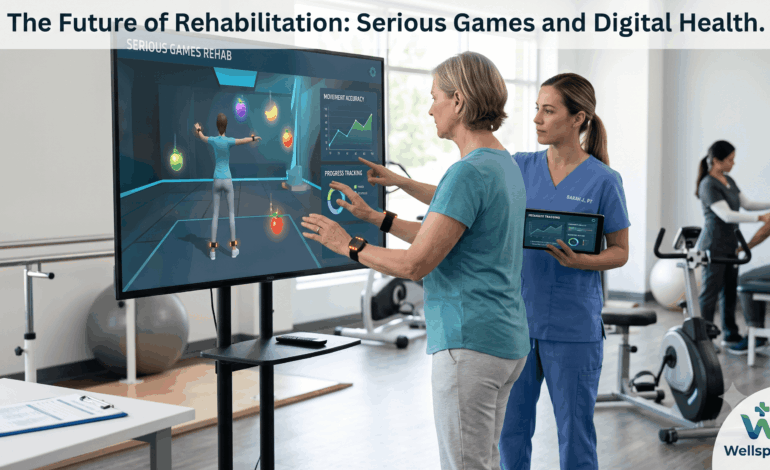
For example, a rehabilitation game may ask a patient to perform certain movements while sensors track their performance. The program can then provide feedback and adjust the activity according to the patient’s ability.
Gamification is slightly different. It adds game-like features to activities that are not traditionally games.
Common gamification features include:
-
Points and rewards
-
Badges
-
Challenges
-
Progress bars
-
Achievement levels
-
Daily goals
-
Streaks
-
Personalized targets
For instance, a physical therapy application may reward patients after they complete their prescribed exercises. Similarly, a health app can use progress tracking to encourage regular physical activity.
Latest Applications of Gamification in Healthcare
1. Serious Games for Neurological Rehabilitation
Neurological rehabilitation is an important area for serious-game research. Repetitive exercises can sometimes become tiring, so interactive games may make these activities more engaging.
For example, a rehabilitation game could ask a patient to move their fingers, hands, arms, or legs to complete a virtual task. Motion sensors can track these movements and provide immediate feedback.
Researchers are exploring game-based rehabilitation for conditions such as:
-
Stroke
-
Parkinson’s disease
-
Traumatic brain injury
-
Movement disorders
-
Balance problems
Furthermore, therapists can review performance data to understand how a patient is progressing. This information may help them select suitable exercises and adjust the difficulty.
2. Cognitive Training and Brain Health
Serious games are also being explored for cognitive stimulation, particularly among older adults. Depending on the design, these games may challenge memory, attention, reaction time, problem-solving, and decision-making.
For example, a game might ask users to remember objects, solve puzzles, or respond quickly to changing information. Such activities can provide mental stimulation, although they do not guarantee protection against dementia.
At the same time, it is important to distinguish structured cognitive training from excessive recreational screen use. Long periods of screen exposure may affect sleep, attention, and daily routines in some people.
For more information, read our guide on excessive screen time and brain health and the discussion around the term “digital dementia.”
Overall, researchers need more evidence to determine whether improvements from cognitive games can transfer to everyday activities.
3. Mental Health and Serious Games
Mental healthcare is another growing area for serious-game research. Some digital interventions use techniques based on cognitive behavioral therapy (CBT).
These programs may help users practice emotional regulation, recognize unhelpful thought patterns, manage stressful situations, and develop healthier habits.
Researchers have explored game-based approaches for:
-
Anxiety
-
Depression
-
Post-traumatic stress disorder (PTSD)
-
Stress
-
Emotional regulation
For people experiencing persistent worry, sleep difficulties, concentration problems, or other anxiety-related symptoms, our guide to anxiety symptoms, warning signs, and when to seek help provides additional information.
In addition, researchers are examining serious games in relation to repetitive behaviors and emotional stress. One example is dermatophagia and other body-focused repetitive behaviors.
However, game-based mental health tools do not work equally well for everyone. Therefore, people with persistent or severe symptoms should seek advice from a qualified healthcare professional.
4. Potential Applications for Autism
Researchers are investigating whether serious games can support certain skills among people with autism.
Depending on the program, game-based activities may focus on:
-
Social interaction
-
Communication
-
Attention
-
Emotional recognition
-
Eye-gaze behavior
-
Emotional regulation
For example, a virtual environment can simulate a social situation in a controlled setting. Users can then practice specific responses in a less stressful environment.
Some early studies have reported encouraging findings. Nevertheless, many studies have included relatively small groups of participants.
As a result, larger and more diverse studies are needed before researchers can determine how effective these interventions are for different populations.
5. Physical Therapy and Movement Retraining
Physical therapy often requires repeated movements. Some patients may find these exercises tiring or monotonous. Gamification can make the process more interactive.
For instance, a rehabilitation game might ask a patient to reach for virtual objects, maintain balance, follow movement patterns, or control an on-screen character.
Meanwhile, cameras and motion sensors can record body movements. The system can then provide immediate feedback about performance.
Researchers are studying game-based rehabilitation for:
-
Stroke recovery
-
Cardiac rehabilitation
-
Pediatric rehabilitation
-
Orthopedic recovery
-
Balance training
-
Motor-control exercises
Most importantly, healthcare professionals should guide therapeutic exercise programs. They can select appropriate activities, adjust difficulty, and monitor patient safety.
6. Medication Reminders and Treatment Adherence
Gamification can also encourage patients to follow medication schedules and other parts of their treatment plans.
For example, a mobile health application may combine reminders with:
-
Daily goals
-
Progress tracking
-
Achievement badges
-
Streaks
-
Personalized notifications
These features can make routine health activities more engaging. Consequently, some users may find it easier to maintain their treatment routines.
Nevertheless, gamified reminders should complement medical advice. Patients should follow their prescribed medication instructions and discuss treatment concerns with their healthcare provider.
7. Patient Education Through Interactive Games
Medical information can sometimes be difficult to understand. Serious games can make certain health topics more interactive and easier to explore.
Healthcare games may teach patients about:
-
Anatomy
-
Diseases
-
Medical procedures
-
Medication use
-
Lifestyle changes
-
Rehabilitation exercises
For example, an interactive simulation can demonstrate how a medical procedure works. As a result, patients may better understand what to expect and prepare questions for their healthcare team.
In addition, game-based learning can be particularly useful when healthcare information needs to be presented in a simple and engaging format.
Technology Behind Modern Healthcare Games
Biofeedback and Wearable Sensors
Biofeedback allows a digital system to respond to information collected from the user’s body.
Depending on the device, sensors may track:
-
Heart rate
-
Movement
-
Breathing
-
Muscle activity
-
Exercise performance
The game can then use this information to change the difficulty or provide personalized feedback.
For example, a rehabilitation program may monitor a patient’s movements during an exercise. If the patient improves, the system can gradually introduce a more challenging activity.
Therefore, biofeedback can help create a more responsive rehabilitation experience.
Artificial Intelligence and Serious Games
Artificial intelligence (AI) is creating new possibilities for personalized healthcare games.
AI systems can analyze information such as movement patterns, game performance, interaction behavior, and certain physiological measurements.
Consequently, an AI-powered healthcare game may:
-
Adjust difficulty automatically
-
Personalize exercises
-
Identify performance patterns
-
Track progress
-
Provide adaptive feedback
-
Support therapist assessments
For example, a rehabilitation game can increase the difficulty when a patient consistently performs an exercise correctly. On the other hand, the system can reduce the challenge when the patient struggles with a particular task.
However, developers must carefully test AI-based healthcare systems. Privacy, data security, accuracy, and clinical oversight remain important considerations.
Virtual Reality and Augmented Reality in Healthcare
Virtual reality and augmented reality can make serious games more immersive. These technologies allow users to interact with digital environments while performing therapeutic or educational activities.
Virtual Reality Therapy
VR places users inside computer-generated environments. Patients can interact with virtual objects while completing specific tasks.
Researchers are exploring VR applications for:
-
Physical rehabilitation
-
Stroke recovery
-
Anxiety-related interventions
-
Pain distraction
-
Burn rehabilitation
-
Motor training
-
Cognitive exercises
For example, VR can provide an immersive distraction during uncomfortable medical procedures. Burn care is one area where researchers have examined this approach.
VR for Stroke Rehabilitation
Researchers are also studying VR for stroke-related problems such as visuospatial neglect.
After a stroke, some people may have difficulty noticing objects or stimuli on one side of their surroundings. Virtual environments can create structured activities that encourage patients to explore and interact with that side.
Early research has shown potential in some rehabilitation settings. However, additional clinical studies are needed to determine the long-term benefits of VR and AR interventions.
Are Serious Games Clinically Effective?
The effectiveness of serious games depends on several factors. These include the specific game, medical condition, patient population, treatment goal, and method of delivery.
A game can increase motivation without necessarily improving a patient’s health outcome. Therefore, researchers need to measure clinical results rather than engagement alone.
Studies may examine:
-
Treatment adherence
-
Physical performance
-
Cognitive function
-
Symptom severity
-
Quality of life
-
Patient knowledge
-
Rehabilitation progress
Furthermore, randomized clinical trials and larger participant groups can provide stronger evidence.
Researchers should also include people from different ages, backgrounds, abilities, and levels of technological experience. This approach can help determine whether a healthcare game works across diverse populations.
Benefits of Gamification for Patients
Increased Motivation
Rewards, challenges, and achievable goals can encourage some patients to participate more consistently.
Greater Engagement
Interactive activities may feel more enjoyable than repetitive exercises for certain users. As a result, patients may remain involved for longer periods.
Progress Tracking
Digital platforms can display completed exercises, activity levels, and changes in performance. Patients and therapists can use this information to understand progress.
Home-Based Participation
Some digital rehabilitation tools allow patients to continue selected activities at home. Therefore, users may receive additional practice between clinical appointments.
Personalized Experiences
AI and sensor technology can adapt activities according to individual performance. Consequently, different patients may receive different levels of challenge.
Challenges and Limitations of Serious Games
Serious games offer several potential benefits. However, they also have important limitations.
Limited Clinical Evidence
Not every healthcare game has undergone rigorous clinical testing. Moreover, research findings can vary between different interventions.
Accessibility
Some systems require smartphones, gaming consoles, VR headsets, wearable sensors, or reliable internet access. These requirements may make certain interventions difficult for some patients to use.
Disability and Usability Barriers
Developers should consider accessibility from the beginning. Otherwise, people with visual, hearing, motor, or cognitive disabilities may experience difficulties while using the technology.
Screen-Time Concerns
Healthcare games still involve digital-device use. Therefore, developers should consider suitable session lengths and regular breaks.
Privacy and Data Security
Healthcare games may collect movement information, behavioral data, physiological measurements, and treatment progress. Consequently, developers need strong privacy and security practices.
Need for Professional Guidance
Some therapeutic games require professional supervision. Healthcare providers can select appropriate exercises, monitor progress, and identify situations that require changes in treatment.
The Future of Healthcare Gamification
The next generation of serious games will likely combine AI, wearable sensors, VR, AR, mobile applications, and clinical care.
Future systems may provide more personalized experiences instead of giving every patient the same exercises.
For example, a rehabilitation platform could use wearable sensors to monitor movement. AI could then analyze the results and adjust the next exercise. At the same time, the system could share progress information with a therapist.
As a result, patients may receive more responsive digital support both inside and outside clinical environments.
Nevertheless, advanced technology does not automatically guarantee better healthcare outcomes. Researchers must continue testing these systems through high-quality clinical studies.
Frequently Asked Questions
Are serious games a replacement for therapy or medication?
No. Serious games generally support established healthcare rather than replace it. Patients should continue following recommendations from qualified healthcare professionals.
Does gamification improve health outcomes?
Gamification can improve motivation and engagement in some situations. However, increased engagement does not automatically produce better health outcomes. Researchers must evaluate each intervention separately.
Can serious games help with anxiety and depression?
Some serious games and digital interventions have been studied for anxiety, depression, and related symptoms. However, results vary between interventions. People with significant symptoms should seek appropriate professional care.
Can serious games detect depression?
Researchers are studying whether gameplay behavior and machine-learning techniques can identify patterns associated with depression. However, this remains an emerging research area and should not replace professional diagnosis.
Can VR games help with rehabilitation?
Researchers are studying VR rehabilitation for stroke and other movement-related conditions. VR can provide interactive training environments and may increase engagement. However, effectiveness depends on the specific program and patient.
Are serious games safe for children?
Safety depends on the child’s age, health condition, game design, and duration of use. Therapeutic games should use age-appropriate content and, when necessary, professional supervision.
Conclusion
Serious games in healthcare represent an expanding area of digital medicine. By combining gamification with AI, biofeedback, VR, AR, and wearable technology, developers can create interactive tools for rehabilitation, cognitive training, mental health support, patient education, and treatment adherence.
The biggest advantage of these technologies is their potential to make repetitive healthcare activities more engaging and measurable. Furthermore, adaptive systems may provide patients with more personalized experiences.
However, serious games are not a universal treatment. Their clinical effectiveness requires strong scientific evidence. At the same time, privacy, accessibility, safety, and professional oversight must remain important priorities.
As healthcare technology develops, collaboration between patients, clinicians, researchers, game designers, and technology developers can help create digital health solutions that are both engaging and medically meaningful.